What will an Andy Burnham Government mean for British Muslims?
5 min read
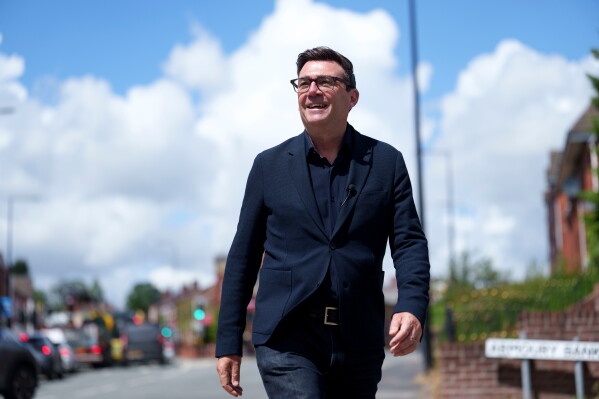
AP Photo / John Super)
For decades, the relationship between British Muslims and the Labour Party appeared remarkably durable. In constituencies across Birmingham, Bradford, Blackburn, Manchester, London and elsewhere, generations of Muslim voters regarded Labour as their natural political home.
That relationship can no longer be taken for granted.
The rupture did not begin with Gaza. There has long been a sour taste in the mouths of many Muslims over how Labour handled the wars in Iraq and Afghanistan. But Gaza brought that disillusionment dramatically into the open. Labour’s response crystallised a wider frustration: that Muslim votes were welcomed, but Muslim concerns were too often treated as inconvenient; that engagement intensified before elections but rarely translated into influence afterwards; and that Muslims were expected to demonstrate their loyalty to Labour more frequently than Labour was required to demonstrate its loyalty to them.
Nothing captured this estrangement more powerfully than Sir Keir Starmer’s October 2023 LBC interview. Asked whether Israel’s decision to cut off power and water to Gaza was appropriate, Starmer replied that Israel “does have that right”, while adding that everything should be done within international law. The remarks caused deep anger among Muslim communities and contributed to the resignation of several Labour councillors.
For many Muslims, the episode appeared to confirm a deeper suspicion: that Palestinian lives were simply not afforded the same moral urgency as others.
The electoral consequences followed. In 2019, 86% of Muslim voters backed Labour. By early 2024, only 43% said they would definitely do so again. At the General Election, Gaza-focused independents demonstrated that they could challenge Labour even in constituencies previously regarded as secure.
Andy Burnham therefore inherits more than a political constituency to win back. He inherits a relationship that needs repairing.
The question is whether his distinctive brand of politics can achieve that reset.
Burnham starts with an advantage: he understands the problem

Andy Burnham, waves as he leaves after delivering a speech in Manchester on 29 June (AFP)
There are reasons for British Muslims to be cautiously optimistic.
Before becoming Prime Minister, Burnham apologised for Labour’s initial response to Gaza. “Labour’s initial response to the treatment of Gaza caused huge hurt. We got it wrong and I am sorry for that,” he wrote.
Crucially, this was not entirely retrospective positioning. By late October 2023, Burnham was already among several prominent Labour figures calling for a ceasefire in Gaza, putting him at odds with Starmer’s position at the time.
His wider politics may also explain why some Muslims will find Burnham an attractive proposition. His years as Mayor of Greater Manchester produced a political style centred on place, devolution and local institutions. His instinct has generally been to bring councils, civic organisations and faith communities into the political process rather than treating government as something done to them from Whitehall.
Perhaps the clearest example is Prevent. As far back as 2016, Burnham described the Prevent brand as “toxic”, arguing that it had created suspicion and distrust within Muslim communities. He subsequently advocated a more community-led approach in Greater Manchester.
Prevent has become symbolic of a wider problem in the relationship between British Muslims and the state: Muslims too often encounter government through the vocabulary of extremism, integration and security rather than citizenship, prosperity and participation.
Burnham appears to understand that.
But there is a harder question: will the instincts of Mayor Burnham survive the institutions of Prime Minister Burnham?
Prevent and Islamophobia will provide the first clues
No serious government can abandon its responsibility to combat terrorism and violent extremism. British Muslims have as much interest in that objective as anybody else.
The dispute is over how it is done.
For many Muslims, Prevent represents an approach in which ordinary expressions of religious and political identity have sometimes become securitised. British Muslims should therefore reasonably expect a Burnham government to be more receptive to community-led alternatives and more conscious of what happens when counter-extremism policy loses the confidence of the communities it is supposed to protect.
They should not, however, assume Prevent will simply disappear. Prime Ministers inherit security institutions and bureaucracies that constrain the instincts politicians display outside Downing Street.
Islamophobia presents a similar test.
Under Burnham’s mayoralty, many local authorities in Greater Manchester adopted the All-Party Parliamentary Group on British Muslims’ definition of Islamophobia as being “rooted in racism” and targeting expressions of Muslimness or perceived Muslimness.
But definitions are the easy part.
The real test is whether government confronts anti-Muslim prejudice when doing so carries a political cost – when inflammatory rhetoric comes not from extremists on the margins but from mainstream politics, the media or even within Labour itself. Also, Burnham can not be directly credited for the adoption of the definition by local authorities who are largely independent, outside the Mayor’s authority, to adopt motions on such topics.
In any case, British Muslims do not need another Prime Minister telling them Islamophobia is unacceptable.
They need to know what government intends to do about it.
Gaza, however, remains the threshold test
Prevent matters. Islamophobia matters. Other issues also matter.
But for many British Muslims, Gaza now comes before the wider conversation about rebuilding trust with Labour.
Westminster risks misunderstanding why.
Gaza matters not simply because Palestinians are overwhelmingly Muslim. It has become a test of moral consistency. If Britain speaks about human rights, international law and the protection of civilians, Muslims increasingly ask whether those principles apply equally when Palestinians are involved.
That is why Burnham’s apology, while significant, will not be enough.
Trust cannot be rebuilt through contrition alone. Muslim voters will look for meaningful action: diplomatic pressure, consequences for illegal settlements, restrictions on arms where there is a credible risk of violations of international humanitarian law, and a willingness to hold the Israeli government to the same standards Britain expects of others.
This is where Burnham’s own history becomes more interesting.
He has previously supported Palestinian statehood and criticised Israeli settlement expansion. But he also joined Labour Friends of Israel during his 2015 leadership campaign and opposed the wider Boycott, Divestment and Sanctions movement. He also said then the first place he would visit upon becoming Prime Minister would be Israel.
There are consequently two ways to read Burnham.
The sceptical interpretation is that, whatever his rhetoric today, he remains a product of a Blairite Labour and Westminster establishment whose room for manoeuvre on Israel will be constrained by longstanding diplomatic and political relationships.
The more optimistic interpretation is that nearly a decade outside Westminster changed him. Greater Manchester placed Burnham closer to diverse communities and further from the Westminster bubble – and on Gaza, he was prepared to diverge from Starmer at a politically sensitive moment.
Perhaps, then, the more interesting question is not whether Burnham can change Westminster.
It is whether Westminster will change Burnham back.
British Muslims should judge him neither by an old affiliation nor a recent apology, but by what his government is prepared to do when principle carries a political cost.
If Burnham acknowledges Labour got Gaza wrong but fails to translate that admission into policy, many Muslims will conclude that little has fundamentally changed. If he demonstrates that international law applies consistently – including to Britain’s allies – he may begin restoring something Labour cannot recover through better messaging alone: moral credibility.
Only then can the wider conversation about Muslims returning to Labour really begin.
But British Muslims are not a single-issue electorate
Here lies the paradox. Gaza may be the threshold issue, but British Muslim politics cannot be reduced to Gaza.
British Muslims are parents worried about mortgages and rents; entrepreneurs trying to grow businesses; graduates looking for work; teachers concerned about schools; patients waiting for NHS appointments; commuters frustrated by transport; and families wondering whether their children will enjoy greater opportunities than they did.
In that sense, much of the British Muslim political agenda is simply the British political agenda.
And this may be where Burnham has the most to offer.
His political brand has been built around housing, transport, public services, regional inequality, jobs, skills and devolution. Many communities that could benefit from that agenda also happen to have significant Muslim populations.
Bradford, Blackburn, Birmingham, Oldham and Rochdale do not primarily require bespoke “Muslim policies”. They require stronger schools, affordable housing, better transport, successful local economies and genuine routes for young people into skilled and professional employment.
One of the failures of British politics has been to encounter Muslims primarily when discussing terrorism, integration or community cohesion.
A healthier relationship would encounter Muslims as entrepreneurs in an economic strategy, parents in an education strategy, patients in an NHS strategy and citizens in a national story.
So what should British Muslims realistically expect?
Not a revolution – and certainly not a government that agrees with Muslims on every issue.
But they can reasonably expect a change in direction.
They should expect Burnham to understand the damage caused by viewing Muslim communities primarily through security. They should expect a more serious approach to Islamophobia and greater willingness to work with Muslim civil society. They should expect his economic agenda to reach towns and cities in which many Muslim families have felt left behind.
And above all, they should expect his acknowledgement of Labour’s failure over Gaza to be followed by actions sufficiently meaningful to demonstrate that the apology was more than political repositioning.
But British Muslims should not simply return to Labour because the language has improved.
For too long, Labour treated Muslim support as something approaching an inheritance. Recent elections have shown that those votes are increasingly contestable. That is not a problem for democracy; it is democracy working as it should.
Burnham’s objective should therefore not be to recreate the old relationship between Labour and British Muslims.
British Muslims should not want him to.
A healthier relationship would be one in which politicians compete for Muslim support, Muslim voters judge them on delivery and political loyalty is earned rather than assumed.
Burnham has an unusual opportunity to build that relationship. His record on Prevent, devolution, community engagement and Gaza suggests he understands at least some of what went wrong.
But understanding the problem is the easy part.
The defining question is whether he is prepared to spend political capital fixing it.
For British Muslims, the appropriate response to a Burnham government is therefore neither immediate enthusiasm nor reflexive cynicism.
It is conditional optimism.
The relationship can be repaired.
But this time, Labour will have to earn it.